Yo, what is this, a military force review? No of course, and while I can sit down and talk for hours about tanks and battleships (I do like them a lot) this is actually about the two-player board game Battleships, one of the games that (hopefully) you have played because you are missing out a lot of you don’t.
For anyone new to this game, you would be given a 10*10 board, on which you will have to place traditionally one 1*2 ship, two 1*3 ships, one 1*4 ship, and one 1*5 ship. Your placement will not be revealed to your opponent and vice versa, and the ultimate goal for both players would be to sink all enemy ships before all of your ships go down by correctly guessing the tile on which their ships are placed. Lots of variances are available to the format of the game, which truly makes playing it a rich experience. Today, I would like to look at the game strategies from a mathematical perspective, because believe it or not, your chance in this seemingly random game can be massively improved using probability calculation.
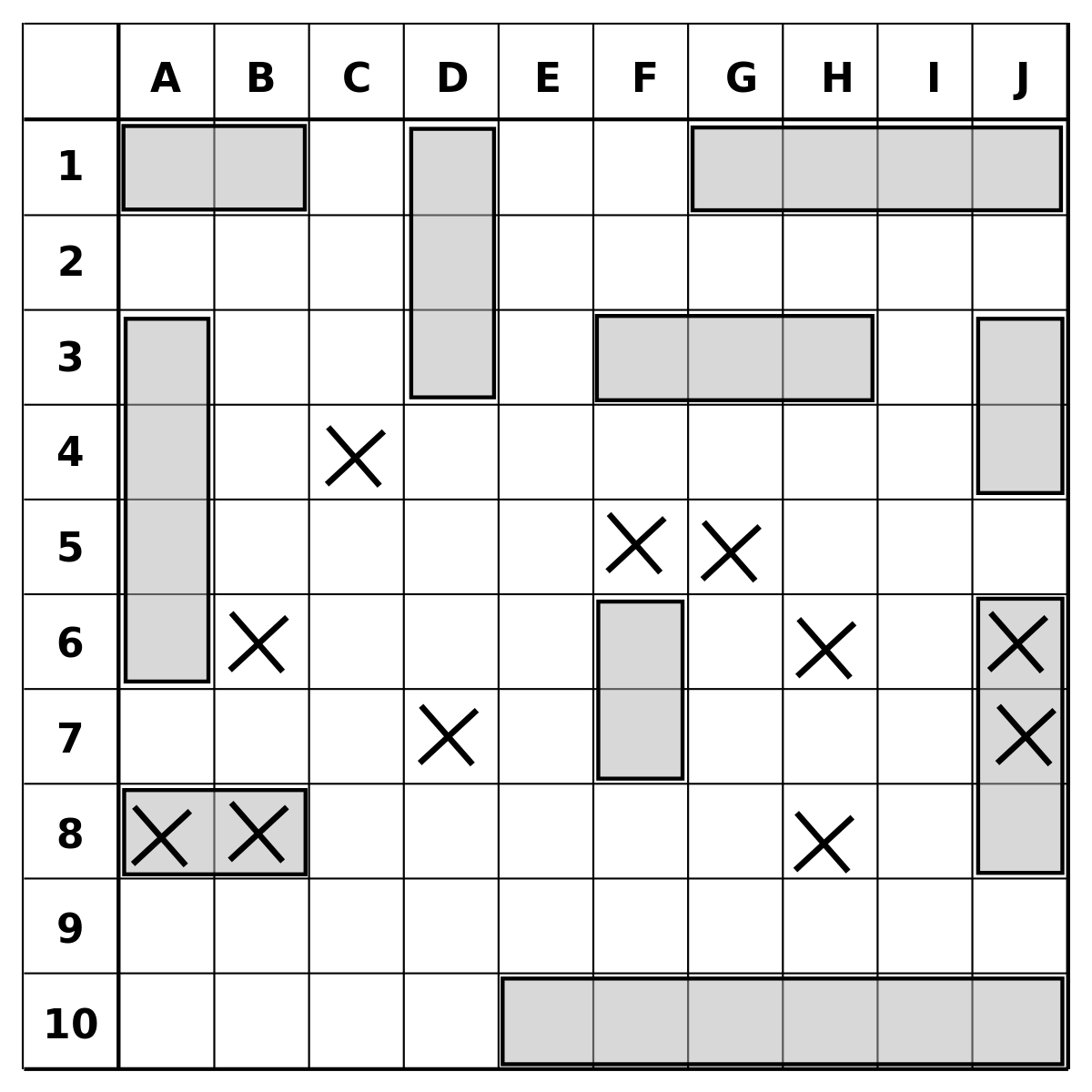
- Offensive side – Guessing strategies:
The very basic first strategy is once you have managed a hit, immediately start playing around that square. Your second shot has a 25% chance of hitting (since you either play leftwards, rightwards, upwards, or downwards) and the third shot onwards until you sink the ship have a 50% chance of hitting each since you can continue the chain of blocks you have just formed. In every case, this is better than random potshots.
The second strategy theoretically reduces the number of moves you need to achieve a victory. If we color the battleship playground in a checkerboard pattern similar to the chessboard, a ship will always occupy at least one black square. Therefore, by attacking the black squares only, the player is assured to get hits in without resulting in random moves (you will be able to detect all enemy ships in below 50 moves a.k.a the number of black squares, which is just half of the board).

The third strategy is the evolutionary strategy. Remember that the way players choose squares to hit are not restricted by game rules, therefore players can adjust their strategies midway through the game, hence the term “evolutionary”. Suppose that you have sunk the 1*2 ship early in the game, and now all ships are 1*3 or longer. Therefore, you would like to avoid hitting 1*2 and 2*2 spaces since there is no longer a chance that a ship will appear inside it. Similarly, the dimensions of the spaces you would like to avoid will increase as you sink more ships, allowing you to focus your moves on other areas.
2. Game variations:
The variations to this game come in several types.
First is the board size, ship size, and ship number. This will heavily affect your chance of hitting, which is calculated by the number of target squares per the total number of squares. For the classic Battleships, the size of the board is 10*10 for a total of 100 squares, and the number of target squares is 17, so the hit chance is 17%. This brings about fast-paced gameplay, as the chance that you miss all 5 first shots are just 39%, way below average. Board variations can be n*n for any value of n, and the number of target squares can be changed by adding ships of the types above and even, in some cases, 2*3 aircraft carriers; but to design the most suitable experience, the hitting ratio will always have to be taken into account. Generally speaking, an initial hit ratio higher than 15% will lead to fast games, while an initial hit ratio lower than 10% will lead to long-winded battles. Moreover, due to the hit-around strategy, large ships are prone to be sunk very early, since they are easier to detect; therefore a game with a large number of small ships will always be slower than a game with a small number of large ships.
The second variation is in the number of shots per salvo, or the number of shots a player is allowed to fire in one turn. Choosing this variation will undoubtedly result in faster games, however, it is noteworthy that the more shots per salvo, the greater the advantage for the first player, since at any given time he will have fired more shots than the second player. For example, if the salvo has 5 shots, at the end of the first player’s turn he will be firing a total of 5 more shots than the second player, a gap that the second player can only breach after he ends his turn. Therefore, for maps with high hit ratios, the first player is prone to end the game faster due to the shots advantage. This makes salvo playing suitable only to low hit-ratio maps (below 10%) as with a long game the advantage will not be as noticeable.
The third variation and the one I like the most is the “ship-dependent” playstyle. In this mode, the number of shots per salvo equals the number of ships you have left. This game mode is fascinating as it directly rewards the sinking of ships with a massive advantage, and therefore demonstrates to the maximum the evolutionary strategy discussed above. Besides the normal approach of detection, a person can also choose to focus on big ships early on and sink them to give an advantage. For example, I always play with my friends a traditional setup of ships (17 target squares) but on a 15*15 board for a hit ratio of 7.55%, suitable for medium-to-long games even for salvo playstyle. I often ignore 3*3 squares from the get-go and instead just focuses on spaces that are 4 squares or longer, allowing me to pick up their 1*4 and 1*5 ships first and reduce their salvo size by 2. As you can see, this game mode focuses on obtaining a lead over the opponents as soon as possible and then builds upon that advantage, so using unorthodox strategies can be very beneficial.
I would like to end this writing with a fun math analysis of what would happen when the “ship-dependent” method above is applied to a high hit ratio map. Take the traditional map of 17% with 5 ships. Before the second player has the chance to do anything, the first player would have had a 61% chance of damaging at least one ship of the second player and a decent chance to sink at least one, especially if the hit-around method is applied. And there is a 1.2% chance that the first player sinks both the 1*2 and the 1*3 ship of the second player in his turn, reducing the second player’s salvo to 3 before the game even begins, which is a death sentence.
That’s why you don’t play salvo in high hit ratio maps!

 Crash on Maths